This piece is about a strategy for reading books, with a good starter definition of "book" being a treatment of a subject that goes over 100 pages. If you want a discussion of shorter works, perhaps see my comments on the Searcher's Internet or The Best of Free Internet.
Part 1 Read what I am supposed to have read.
I at first considered putting supposed in quotes (like this: "supposed") but I think we have more of a common understanding what that means than you'd think from our default relativism and rush-from-judgment ways. I think there it would be relatively easy to construct an algorithm for a person feels they should have read if you followed someone around and listened to all of their conversations. The combination of data from a cell phone and Alexa would work nicely for many so-cool cutting-edge modern Americans. I don't mean to state I know how to do the job of the masters of our tiny universe, and almost certainly this will never be what they use their surveillance for, but I imagine the algorithm would either be based on how many times a book or author was mentioned, or perhaps we would need a weighting based on who mentioned the book, opinion leaders being something else I feel it would be easy enough to model. Either way, once the data was established, I think an X percent could be established for how likely we are to state we wish we had read it a book.
I try to read all of those books that form that set for me. Since I was in elementary school I have been able to adopt the tactic of getting through difficult, not super fun books by reading at 10 pages a day until they are done. I don't know why reading needs to be more difficult than this.
Part 2. Read what what "no one" has read.
This time I am using quote marks, because obviously it can't literary be true that no one has read these books. If nothing else, the author had to read it. But really, I just mean read things no one else in my social circle has read.
One benefit of reading what no reads is that I have things to bring up in conversation, different stories, statistics, and anecdotes than anyone else. I remember one time I had read a book from over a hundred years ago about mechanical and electrical tinkering. That evening at a meal with my wife's family I mentioned how funny I thought it was that the took for granted the uses of asbestos. The adults had a laugh and my nephew and the girl he was with did that slight little freeze up thing when you have no idea what someone is talking about. I made light of this, and we all had another little laugh. I may not be world-class weird, but I sure am weird to a small group of people whom I care about.
Another great thing about reading these kinds of obscure books is that it allows me to get practice seeing completely with my own eyes. Since the coming of the printing press, one of the most important arguments for reading has been its ability to transport the reader to other places, thus freeing them from the parochial and mundane. However, when you move past books people should have read to the books people claim to have read (note: experience has taught me to not believe most people when they say they have), you run into the baggage of interpretations and expectations (even if they are lying about having read the work in question). When you read a book no one else knows anything about, you have no choice but to think for yourself.
Ideally, that skill would transfer to other domains, but that a rare thing indeed. However, if nothing else, all this book reading takes you away from advertisements, (lazy) fools, and narcissists. To make a turn on a point Camus made about wealth, the time spent reading can only earn you a reprieve. But a reprieve is always worth taking.
Monday, June 3, 2019
Friday, May 31, 2019
A Philosophy of No Comments
If I had not gone through my time of grief -- with my grandfather, father and uncle dying within a year and ten days of each other and then needing to assume roles in the care of my grandmother that most would see as unfair for a thirty year old -- then perhaps I would have comments available.
But instead, the truism "life is too short" hits me in visceral ways that it clearly doesn't for others. Lip-service is paid to understanding the truth, but people show through their actions that they think they have all the time in the world to waste on arguments with fools and/or those acting in bad faith. The real problem: a public forum just encourages too many people to perform. I am not going to participate in a forum of fools, and I sure as hell not going to create one. While the sidebar states you are the co-owner of the content, and you are, bad people are not co-owners of my time.
On the topic of adulation, I am less sure. I don't know the balance between the time spent reading comments versus a possible boast in productivity in feeling better about my work. But realistically, that calculus has more to do with how the rest of my life is going. And so, on second thought, I'm confident that the benefits are really not worth the costs. I should just focus on living well.
One thing I think I miss out on, especially compared the comment sections of John Michael Greer or Scott Alexander, is a stream of related books, articles and ideas related to a post. But then, I do have my e-mail over on the side. If you have any of those contributions, please do e-mail me. Ideally, I would also be sent links showing who came up with related ideas before me, or those who just express them much better, so I can update my own post and give credit where it is due.

Wednesday, May 29, 2019
The Best that I can Get
On April 20th, I gave up on my Mach 3 razor cartridge and put a new one in. A big part of why I write this post is to have a record of how long this new cartridge will last.
Extending the life of a disposable razor is one of those rabbit holes that YouTube will happily let you go down as long as you want. In one of the comment sections, I saw someone claim that his razor lasted for three years, and that the plastic that held the blades broke, making that the only limiting factor against a blade last indefinitely.
This was not my experience. But I wanted it to be. I'll admit that I had this comment in mind when I bought a ten pack, thinking "will I really be able to make this last thirty years? Could these be the last razors I ever need to buy?"
With the ardor of a cheap-skate, I adopted the following strategies: 1) using some old denim to run the blade backwards (called stropping, I had learned), 2) drying the blade and putting it in a Ziploc bag 3) ritualistically removing the gunk from between the blades, either through blowing or picking it out using, say, the lead of a mechanical pencil 4) using vegetable oil as an extra lubricant when I shave (I use regular bar soap to make the lather I shave with. I am still on bars of soap I collected from hotels when I used to go on more trips.)
I think that items 3 and 4 might be the potential causes of failure, particularly number 3. I think picking at the blades so much messed with the geometry of the cutting action. Toward the end, my blade would not cut certain parts of my chin. I extended the life one more week by taking more than one pass, alternating going with and against the grain, but eventually -- April 20th, to be exact -- I found there were places I just could not shave with the blade.
I am happy to remove some time-wasting rituals now that I have found that they are not just unproductive, but in fact counter-productive. Such is the way when you go past the minimum effective dose.
Now I only dry the blade after use and seal it up in a bag to prevent moisture coming in. I am holding off on using denim to strop the blade because there is a school of thought that it can actually speed up the process of dulling the blade. Also, to make a confession, I am probably going to be happy with how long the blade lasts either way.
After all, let's examine what the real stakes are here. According to one apostle of frugality:
If you run the numbers on buying Mach 3 razors, it's about $2 a cartridge. If I get sixty days out of it, that's already just three and a third cents a day. At ninety days, it's a little over two cents. How much cheaper does a shave need to be? Do I really need to get to 200 days, just so the cost moves down below a penny a day? This is very much a case of diminishing returns.
I'm happy to extend the life a cartridge a bit, especially if it is easy to do, but it's not going to make or break my finances. The real games are still debt, housing, transportation, and food. The savings from one home-cooked meal a SEASON could pay for that season's blade use.
Still, all this reading, thinking, and experimentation gives some meaning and interest to something as mundane as shaving.
Extending the life of a disposable razor is one of those rabbit holes that YouTube will happily let you go down as long as you want. In one of the comment sections, I saw someone claim that his razor lasted for three years, and that the plastic that held the blades broke, making that the only limiting factor against a blade last indefinitely.
This was not my experience. But I wanted it to be. I'll admit that I had this comment in mind when I bought a ten pack, thinking "will I really be able to make this last thirty years? Could these be the last razors I ever need to buy?"
With the ardor of a cheap-skate, I adopted the following strategies: 1) using some old denim to run the blade backwards (called stropping, I had learned), 2) drying the blade and putting it in a Ziploc bag 3) ritualistically removing the gunk from between the blades, either through blowing or picking it out using, say, the lead of a mechanical pencil 4) using vegetable oil as an extra lubricant when I shave (I use regular bar soap to make the lather I shave with. I am still on bars of soap I collected from hotels when I used to go on more trips.)
I think that items 3 and 4 might be the potential causes of failure, particularly number 3. I think picking at the blades so much messed with the geometry of the cutting action. Toward the end, my blade would not cut certain parts of my chin. I extended the life one more week by taking more than one pass, alternating going with and against the grain, but eventually -- April 20th, to be exact -- I found there were places I just could not shave with the blade.
I am happy to remove some time-wasting rituals now that I have found that they are not just unproductive, but in fact counter-productive. Such is the way when you go past the minimum effective dose.
Now I only dry the blade after use and seal it up in a bag to prevent moisture coming in. I am holding off on using denim to strop the blade because there is a school of thought that it can actually speed up the process of dulling the blade. Also, to make a confession, I am probably going to be happy with how long the blade lasts either way.
After all, let's examine what the real stakes are here. According to one apostle of frugality:
I know this might all sound crazy to you. But if you’re used to using a zillion dollar Gillette or Schick and you can stretch it for weeks or even months, we’re talking about real dough you’re saving. This is just 1 example of a way to make a difference in your wallet. That money feels better in my wallet than in Gillette’s or Schick’s.Let's put a more specific number on this than "a zillion" . . .
If you run the numbers on buying Mach 3 razors, it's about $2 a cartridge. If I get sixty days out of it, that's already just three and a third cents a day. At ninety days, it's a little over two cents. How much cheaper does a shave need to be? Do I really need to get to 200 days, just so the cost moves down below a penny a day? This is very much a case of diminishing returns.
I'm happy to extend the life a cartridge a bit, especially if it is easy to do, but it's not going to make or break my finances. The real games are still debt, housing, transportation, and food. The savings from one home-cooked meal a SEASON could pay for that season's blade use.
Still, all this reading, thinking, and experimentation gives some meaning and interest to something as mundane as shaving.
Monday, May 27, 2019
Unfold this Pearl-like Nugget of Pure Light
If you can item unfold #2 from Venkatesh Rao's newsletter (#1 left for context) you will be enlightened to our present and future:
The rest of the piece is also great, hinging on legibility and its discontents, and then offers hope -- for less than 10% of organizations. Happy hunting.
1/ In principle, capability maturity models (CMMs) are to organizations what learning curves are to individuals, a description and prescription of the path to mastery of a well-defined capability that can be exercised by an organization at a systemic level.
2/ In practice, they are sadly more often a recipe for creating a new layer of bureaucracy in the organization, and a whole new class of face-saving sinecures for failing or plateaued mid-career types to safely retreat to.See also Bullshit Jobs, Tournament Theory, and The Abolition of Work.
The rest of the piece is also great, hinging on legibility and its discontents, and then offers hope -- for less than 10% of organizations. Happy hunting.
Friday, May 24, 2019
Giving the Fruit Trees Some Love
I'm very well pleased with my decision to take a break (mostly) from vegetables this year. It's allowed me to focus more on the needs of the fruit trees. And while it looks like pruning should be filed under robot work in our great and glorious future, I like having an excuse to go outside. It's a joy to see the occasional ladybug, or whatever the outside eco-system has in store for me that day (I mean, within reason).
When I was most heavily dealing with grief, I felt the need to walk and wander, and so it was good to have a place like Sutton Wilderness. But with time, it is often enough to poke around the margins of the grounds to fill my yearning for nature and my sense of wonder.
The eye craves variety, and the hands something to do. That and getting out on a perfect hour seems to be enough. . . most days.
Wednesday, May 22, 2019
Locate the Minimum Effective Dose
Credit where credit is due, I first heard this explained in Tim Ferriss's The Four Hour Body. First, I'll paraphrase the idea and his explanation: there is a minimum effective dose (MED) of sun exposure that you need to get a tan. That is all well and good. But once you reach that amount of sun, not only do you not need any more sun exposure to get your result, but each additional unit at least risks something else bad happening -- such as a sunburn, dehydration, cancer.
Understanding the existence of MEDs and thinking about the risks in going over them are crucial critical thinking tools, necessary to cobble together a good life. (If you have a good life without the need for that critical thinking, then you should be thankful that you were raised in the best of families, one that ignored the culture around them and gave you everything you needed by habit. For the rest of us, we'll have to think and reflect.) In the modern world, we are for the most part blind to minimum effective doses, having much to do with the kind of de-skilling necessary to make consumerism (and our job system) work.
Show me a workaholic, and I'll show you someone jeopardizing their relationships with friends and family. What is more, a workaholic often engages in behaviors that endanger the work itself. From the book Rework by Jason Fried and David Heinemeier Hansson (pg 25):
==
Update.
The MED is connected to the concept of Slack, as presented on Less Wrong. This comment also helps add domain-specific rigor:
Understanding the existence of MEDs and thinking about the risks in going over them are crucial critical thinking tools, necessary to cobble together a good life. (If you have a good life without the need for that critical thinking, then you should be thankful that you were raised in the best of families, one that ignored the culture around them and gave you everything you needed by habit. For the rest of us, we'll have to think and reflect.) In the modern world, we are for the most part blind to minimum effective doses, having much to do with the kind of de-skilling necessary to make consumerism (and our job system) work.
Show me a workaholic, and I'll show you someone jeopardizing their relationships with friends and family. What is more, a workaholic often engages in behaviors that endanger the work itself. From the book Rework by Jason Fried and David Heinemeier Hansson (pg 25):
Workaholics miss the point, too. They try to fix problems by throwing sheer hours at them. They try to make up for intellectual laziness with brute force. This results in inelegant solutions.
They even create crises. They don't look for ways to be more efficient because they actually like working overtime. They enjoy feeling like heroes. They create problems (often unwittingly) just so they can get off on working more.In all things, locate the minimum effective dose.
==
Update.
The MED is connected to the concept of Slack, as presented on Less Wrong. This comment also helps add domain-specific rigor:
If you work with distributed systems, by which I mean any system that must pass information between multiple, tightly integrated subsystems, there is a well understood concept of maximum sustainable load and we know that number to be roughly 60% of maximum possible load for all systems.
[. . . ]
"Slack" is a decent way of putting this, but we can be pretty precise and say you need ~40% slack to optimize throughput: more and you tip into being "lazy", less and you become "overworked".
Porting My Twitter Over, Part 3
Aphorisms/Shorts
You probably need AI to enforce rules against AI.
(To make at home) Cold brew coffee tastes better, but requires planning ahead. Normal coffee requires no prior work and has more caffeine. You know which one wins most days.
"Even the class in the Dead Poet's Society was in rows." -- my wife.
The only thing we have to fear is confidence itself.
"It's the thought that counts" is an expression that was almost certainly created within the context of a family, and it only seems to work in that context. The fact that so many people today spend so little time or attention in the domestic sphere makes the saying seem to ring totally false.
I've never met someone who appreciated, or even kept, a participation trophy. Kids don't ask for them. Kids aren't in charge of the situation. They're not for the kids. They're for the parents, you idiots.
Complaining on the internet for an hour is easier and has more 1) short term and 2) guaranteed pay-off than spending that same hour working on a problem. Now, repeat that across our species over billion of total hours . . .
If “show me, don’t tell me” was always correct writing advice, then Shakespeare would never have had asides. And Hamlet would have never said “to be, or not to be."
Being a relatively smart person hasn't yielded too many benefits in my life, but here is one: I have the cognitive skills and the memory to keep track of when people are thoughtful and careful with language to some people and not to others.
You fail to get warmth from 100% of fires you don't start.
Interesting is easier to hack than beautiful. Hence, prioritize the beautiful over the interesting . . . especially in interesting times.
At what point do you start adapting to a new reality, instead of just fashionably whining?
Probably the best idea, as measured by possible utility to the human race, I've had in months. But, alas, oh alack! -- such is the nature of ideas: they need fertile ground to grow:
You probably need AI to enforce rules against AI.
(To make at home) Cold brew coffee tastes better, but requires planning ahead. Normal coffee requires no prior work and has more caffeine. You know which one wins most days.
"Even the class in the Dead Poet's Society was in rows." -- my wife.
The only thing we have to fear is confidence itself.
"It's the thought that counts" is an expression that was almost certainly created within the context of a family, and it only seems to work in that context. The fact that so many people today spend so little time or attention in the domestic sphere makes the saying seem to ring totally false.
I've never met someone who appreciated, or even kept, a participation trophy. Kids don't ask for them. Kids aren't in charge of the situation. They're not for the kids. They're for the parents, you idiots.
Complaining on the internet for an hour is easier and has more 1) short term and 2) guaranteed pay-off than spending that same hour working on a problem. Now, repeat that across our species over billion of total hours . . .
If “show me, don’t tell me” was always correct writing advice, then Shakespeare would never have had asides. And Hamlet would have never said “to be, or not to be."
Being a relatively smart person hasn't yielded too many benefits in my life, but here is one: I have the cognitive skills and the memory to keep track of when people are thoughtful and careful with language to some people and not to others.
You fail to get warmth from 100% of fires you don't start.
Interesting is easier to hack than beautiful. Hence, prioritize the beautiful over the interesting . . . especially in interesting times.
If the spoilers alone were enough to ruin something you were going to watch, then it wasn't worth watching.
At what point do you start adapting to a new reality, instead of just fashionably whining?
Probably the best idea, as measured by possible utility to the human race, I've had in months. But, alas, oh alack! -- such is the nature of ideas: they need fertile ground to grow:
Get rid of the free throws in basketball; instead, every second foul place the player in a penalty box for 1 minute of game play.
Monday, May 20, 2019
Turning Left is Evil
You might even say that to turn left is sinister.
The inability of others to make left turns at a light without coming into my lane is a weekly (at least) reminder of the carelessness and incompetence of those around me, and why I'll never lose all of my misanthropic tendencies. Is it really so hard to gradually flatten the wheel throughout the turn, rather than taking one sharp stab at it?
More understandable, but also more inconveniencing, is someone stopping the flow of traffic to make a left across several lanes to get to their destination.
It also turns out that left-hand turns are bad for the planet without providing compensating utility. From this article on smart logistics (emphasis mine):
UPS began to study ways to maximize shipping routes to limit time idling and save fuel, getting deliveries there faster by learning optimal shipping routes. ORION is a 1000 page algorithm that can learn shipping routes and use that knowledge to find inefficiencies and streamline the shipping and delivery process.
One of the earliest interventions was doing away with left-hand turns wherever possible. UPS drivers knew this trick already, but the algorithm was able to prove its effectiveness. Utilizing data from GPS, driver habits, and more, ORION was able to save 10 million gallons of fuel annually while eliminating 100,000 metric tons of CO2 emissions and saving up to $400 million in shipping costs by the end of 2016.
Friday, May 17, 2019
Fun with Word Mentions
If you type in "define" as well as a word into google, you will usually get not only a definition and etymology, but also a chart with the word's usage over time. Here are some words that I think help tell the story of the United States during the modern (post WWII) period.
asshole
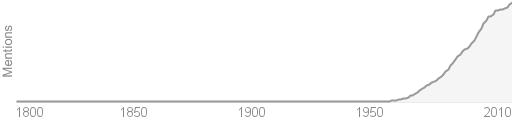
So, there has been an explosion of these types of people since World War II, aka The Gasoline War. What kind of society were we building at that time?
exurb

exurbia

For a brief time, it was understood by Americans that they were making something new and different, that those levels of sprawl don't amount to a real connection with the main city we wanted to swoop into for goods and services at command, afterwards retreating to utopian "good neighborhoods." A new term was coined and brought into usage. But "exurb" was not destined to replace "suburb."
suburb

suburbia

The cultural suicide of the Big Three Era didn't make the suburb. It made suburbia.
racism

I think this one is first about the awareness of racism, and then its continued rise in use comes as a cold-prickly-style insult.
awesome

It often takes a non-American perspective to see how ridiculous our usage of this word is.
bargain

Everyone wants a bargain. Also, I just wanted a word to serve as a baseline. Not every usage has exploded here in the modern era. In fact. . .
dignity

Yeah. . .
asshole
So, there has been an explosion of these types of people since World War II, aka The Gasoline War. What kind of society were we building at that time?
exurb
exurbia
For a brief time, it was understood by Americans that they were making something new and different, that those levels of sprawl don't amount to a real connection with the main city we wanted to swoop into for goods and services at command, afterwards retreating to utopian "good neighborhoods." A new term was coined and brought into usage. But "exurb" was not destined to replace "suburb."
suburb
suburbia
The cultural suicide of the Big Three Era didn't make the suburb. It made suburbia.
racism
I think this one is first about the awareness of racism, and then its continued rise in use comes as a cold-prickly-style insult.
awesome
It often takes a non-American perspective to see how ridiculous our usage of this word is.
bargain
Everyone wants a bargain. Also, I just wanted a word to serve as a baseline. Not every usage has exploded here in the modern era. In fact. . .
dignity
Yeah. . .
Porting My Twitter Over, Part 2
My Aphorisms/Shorts
The revolution will be upcycled . . . and then modular. Or it won't be much of revolution, now will it?
I have not lost the ability to dream; I have lost the ability to pretend that other people will follow any of my dreams.
Self driving cars could be called auto-automobiles. I'd also accept them being called "autobots."
Inside of consumerism, "sufficient luxury" is an oxymoron. Outside of consumerism, you can live a meaningful life.
I'm only interested in listening to people who listen to other people.
There is enough beauty and wonder to go around. There cannot be enough results.
The American Ideal is someone who looks extremely fit, but who works constantly at a job where they sit (a seat of power, as it were).
Devil's advocate: these violent video games these boys want to play might be safer than the mythology games our political tribes want to play on anti-social media.
The way nature shows defiance is beautiful, it "defies expectations." The defiance also seems to give boundless energy. But when some human-type-person who is obsessed with hierarchy shows defiance, is there anything more ugly? Is there anything more sapping?
I'm sick of hating narcissists. When you do that in America, you almost run out of people.
America: worry about everything while making sure you don't care about anything.
I propose that we have 73 Five-Day Weeks (73*5 = 365). We could call the leap year day "Leap Day" and then all of our days of the week would line up every year.
A re-write for Batman v Superman:
After the "space 9-11" scene, start with Bruce Wayne in board meetings with Lex Luthor, plotting to deal with the alien threat. The arc of the movie would then be Wayne realizing Superman is a good guy, turning on Luthor. This would allow for Batman to start fighting Superman in Act I, or Act II by the latest. And it would even give a structural reason for Doomsday to be worked into the end as Luthor scrambles to find a way to defeat the Justice League that is forming in front of him.
Luthor and Wayne would work as foils and commentary upon each other, including daddy issues.
Wednesday, May 15, 2019
On Feeling Alive
I don't think you can force yourself feel alive any more than you can force yourself to sleep. The analogy is illuminating: like sleep, when you want to set out to feel alive, the best you can do is work on your environment, figure out what does and doesn't work for you, and try to eliminate enough of what doesn't work to leave some parts of yourself deeper than your awareness to do their job [1].
One level of explanation is that the act of forcing floods your nervous system with the wrong kind of hormones. In both cases, we really haven't figured out artificial ways to get where we want to go that are side-effect free or effective long-term, though there are those who will swear by each and/or every artificial means you can name.
As a strategy for feeling alive it still seems that the best practice is to free up your schedule so you are available when the different variables come together to make these moments possible. As Thoreau says
There were times when I could not afford to sacrifice the bloom of the present moment to any work, whether of the head or hands. I love a broad margin to my life.And Taleb has something useful to add with this aphorism:
The English have random Mediterranean weather; but they go to Spain because their free hours aren't free.Not only do you have to be physically free -- able to go outside during a perfect hour, and as Taleb shows more days have perfect hours than most people would suppose -- but you also need to be mentally free for the moment when it is presented. Thus, it is wise to look ahead and not fill your mind with junk, particularly resentments and longings.
I'll speak from my own case. While filling my mind poorly doesn't feel that bad at the time-- after most internet feeder sessions, I might feel a bit icky, but not that icky -- the real problem is that it cedes future head-space that I could use for beauty. And feeling alive is worth the sacrifices and the planning ahead.
===
[1] Or, I like the thought experiment of seeing those parts as above you, or pulling you up, or along . . . conceptualize it in different ways, as you wish.
Monday, May 13, 2019
Round Up #17
From Searches and Surfing
Bold prediction on Alzheimer's by a Professor of Medicine at Dartmouth College:
I had no idea the extent China was investing in the rest of the world. I really need to start learning more about China if I am going to understand the future.
Speaking of China, Jimmy Carter had this to say
#generative on twitter makes me happy, especially this.
How Seven Nation Army became an anthem chant.
The Outline making the case that the Trump presidency has been good for psychedelic drug research. In our politically polarized climate, neglect has probably been optimal.
Check out the Degringolade Dreamwidth journal. The dictionary definition of degringolade is "a rapid decline or deterioration (as in strength, position, or condition) : downfall." Here's a good post to start with. And here is the older blog before it was moved to Dreamwidth.
Aphorisms and Shorts
When neither side engages in good faith, any instance of being correct is purely coincidental.
Corollary: I refuse to praise tribe-D or tribe-R at this point.
Related: be very suspicious of any take-down that assumes each and every thing someone else stated is wrong.
"We hyper[-]manage our identities. We hurt each other. We go out and buy some shit. Bonus points when we do all three at once." td0s of Pray for Calamity
Rick Sanchez says ". . . being nice is something stupid people to hedge their bets." But really, intelligence is a way that dark people keep going in darkness longer than they should.
Boston is a riddle. New York City is an explanation. (Cribbed from C.K. Chesterton on London versus Paris).
Bold prediction on Alzheimer's by a Professor of Medicine at Dartmouth College:
Not only have there been more than 200 failed trials for Alzheimer’s, it’s been clear for some time that researchers are likely decades away from being able to treat this dreaded disease. Which leads me to a prediction: There will be no effective therapy for Alzheimer’s disease in my lifetime.The rest of the article gives some strong arguments as to why this might be the case.
I had no idea the extent China was investing in the rest of the world. I really need to start learning more about China if I am going to understand the future.
Speaking of China, Jimmy Carter had this to say
“Since 1979, do you know how many times China has been at war with anybody?” Carter asked. “None. And we have stayed at war.” The U.S., he noted, has only enjoyed 16 years of peace in its 242-year history, making the country “the most warlike nation in the history of the world,” Carter said. This is, he said, because of America’s tendency to force other nations to “adopt our American principles.”Carter is one of those rare people who gets more radical as he gets older. And I love it.
#generative on twitter makes me happy, especially this.
How Seven Nation Army became an anthem chant.
The Outline making the case that the Trump presidency has been good for psychedelic drug research. In our politically polarized climate, neglect has probably been optimal.
Check out the Degringolade Dreamwidth journal. The dictionary definition of degringolade is "a rapid decline or deterioration (as in strength, position, or condition) : downfall." Here's a good post to start with. And here is the older blog before it was moved to Dreamwidth.
Aphorisms and Shorts
When neither side engages in good faith, any instance of being correct is purely coincidental.
Corollary: I refuse to praise tribe-D or tribe-R at this point.
Related: be very suspicious of any take-down that assumes each and every thing someone else stated is wrong.
"We hyper[-]manage our identities. We hurt each other. We go out and buy some shit. Bonus points when we do all three at once." td0s of Pray for Calamity
Rick Sanchez says ". . . being nice is something stupid people to hedge their bets." But really, intelligence is a way that dark people keep going in darkness longer than they should.
Boston is a riddle. New York City is an explanation. (Cribbed from C.K. Chesterton on London versus Paris).
Subscribe to:
Posts (Atom)